The Perth Swing Dance Society (PSDS) is a non-profit organisation, committed to actively promoting swing dancing, its music and culture in Western Australia.
About
The Perth Swing Dance Society wish to acknowledge the traditional custodians of the land we live and dance on, the Whadjuk people of the Noongar nation. We wish to acknowledge and respect their continuing culture and the contribution they make to the life of this city and this region. Always was, always will be, Aboriginal land.
What is the Perth Swing Dance Society?
The Perth Swing Dance Society (PSDS) is a non-profit organisation, committed to actively promoting swing dancing, its music and culture in Western Australia.
The PSDS is run by a volunteer committee of swing dancers. The committee aims to support the Perth swing scene by holding events through out the year, facilitating Hullabaloo every April and helping keep the Perth Swing scene informed about everything swing that’s happening in Perth, Australia and the world!
Perth Swing Dance Society Constitution
If you would like to see the rules, committee breakdown, how the PSDS is run and set up as an association you are welcome to read our constitution.
What is Swing Dancing?
Put simply, swing dancing is dancing to swinging jazz music. The most celebrated of the swing dances is the 1930s partner dance ‘The Lindy Hop’, also known to many as ‘Jitterbug’. The majority of swing dances began in African American communities.
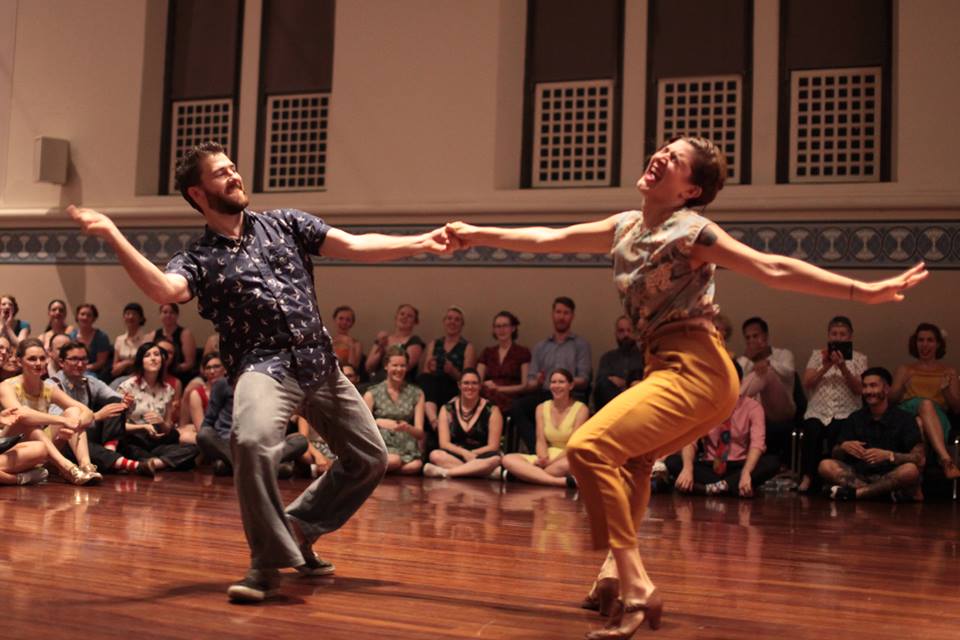
The Lindy Hop
The Lindy Hop is familiar to many people because of its acrobatic ‘air steps’ (aerials) – where the dancers are thrown over their partner’s heads, but this is only one aspect of the dance. A couple dancing the Lindy Hop move with each other in a variety of combinations, sometimes together (closed) and sometimes apart (open). When done well, their movements are characterised by improvisation and rhythm, just like jazz music. The essence of social Lindy Hop is the focus on partner connection, working the floor, and moving as one with the music. Exuberance and craziness are encouraged!
Lindy Hop is thought of as a fast and energetic dance, but as it is danced socially it ranges through all tempos – anywhere from fast and explosive, right down to slow, graceful & sexy! It’s a joyful dance suitable for all ages, but most importantly the emphasis is always on fun!
To see some of the best examples of Lindy Hop, check out the dance sequences from the films ‘A Day At The Races‘ (1937) and ‘Hellzapoppin‘ (1941). You can also find it in modern films such as ‘Malcolm X‘ (1992), ‘Swing Kids’ (1993) and Outkast’s ‘Idlewild’ (2006).
History
Named after aviator Charles Lindbergh’s epic first solo flight across the Atlantic, the Lindy Hop evolved from the Charleston and other dances in late 1920s New York.
Harlem’s popular Savoy Ballroom was the place to be, attracting the best big bands of the time and dancers ready to revel. This atmosphere, along with friendly rivalry between the dancers, helped give birth to the dance. The better dancers invented wilder, fancier and more spectacular moves in an attempt to out-do each other.
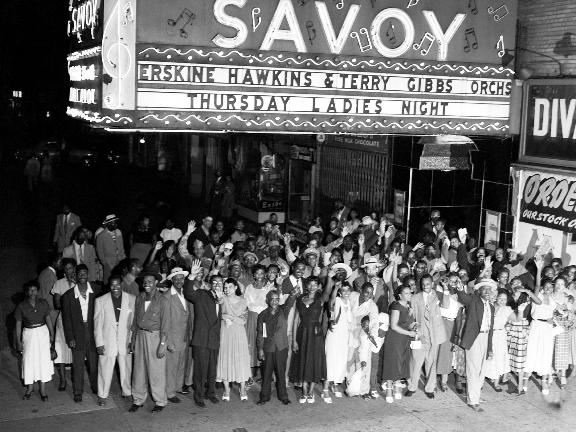
Pic: Savoy Ballroom, Harlem
Big band swing, played by the likes of Duke Ellington, Cab Calloway, Chick Webb, Benny Goodman and Count Basie, grew in popularity throughout the 1930s and into the 1940s. The Lindy Hop craze spread with it across the US and throughout the world.
Stylistic and regional variations of the dance developed, and in popular culture it became known as ‘The Jitterbug’ – as it was known in Australia. Australia caught the Jitterbug craze with the influx of American servicemen during the Second World War. Aussie Jitterbuggers could pick up the latest steps by carefully studying American newsreel footage and films at the local theatres.
The Second World War split up many of the swing bands, and along with shifting music trends it was difficult to maintain a big band in the post-war era. As a result, the popularity of Lindy Hop and other swing dances had largely faded by the mid-1950s. Rock ‘n’ Roll music took over and Jitterbuggers adapted to what became entirely different dance styles. (‘Rock n Roll’ and ‘Jive’)
Fortunately, the Lindy Hop was kept alive – being slowly revived during the 1980s independently around the world by curious and dedicated dancers. The revival was complete by the mid-1990s, with wide media recognition and a fad for retro swing bands such as Royal Crown Revue and Big Bad Voodoo Daddy. Swing dancing was back!
Whitey’s Lindy Hoppers
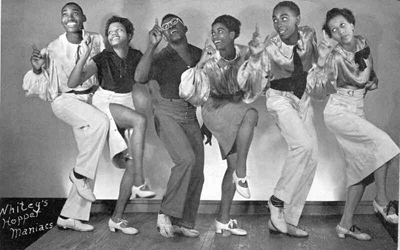
Pic: Whitey’s Hopping Maniacs
Whitey’s Lindy Hoppers were one of the most famous dance troupes in Lindy Hop history. They were a professional performing group of Savoy Ballroom swing dancers, started in 1935 by Herbert ‘Whitey’ White and performed under various names. In addition to touring both nationally and internationally, the group appeared in a number of feature films and Broadway productions.
Of all the members of Whitey’s Lindy Hoppers, Al Minns, Leon James and Frankie Manning, and Norma Miller are amongst the most famous – Minns and James in part for their role in the research of Jean and Marshall Stearns‘s influential book Jazz Dance, Minns for his work with The Rhythm Hot Shots in Sweden during the 1980s’ swing revival, and Manning for his role, starting in 1986, in contributing to the swing and Lindy Hop revival after Minns died in 1985. Manning, Lennie Bluett and Norma Miller were among the few members of Whitey’s Lindy Hoppers still alive during the 1990s and 2000s and were some of that era’s most influential Lindy Hop performers and instructors. With Manning’s death in April 2009, Miller alone remains to teach and lecture at dance workshops and Lindy Hop conventions. Frankie Manning visited Perth to teach Lindy Hop three times thanks to Swing It Out and Swing Junction – two of Perth’s original swing schools.
Other Swing Dances
Other more regionalized swing dances developed in the Swing era, such as Balboa and Collegiate Shag.
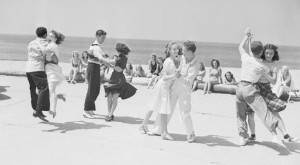
Pic: Balboa dancers, 1930s. Corbis
Balboa, for instance, is a more compact and subtle dance that came from Newport, California. Because the footwork is kept small, it can be danced to medium to extremely fast tempos. Early Balboa (it’s original pure form) was danced completely in closed position. It evolved in conservative dance halls where space was limited. Later on, many of the original Balboa dancers grew bored of doing just pure Balboa and started to introduce fancier variations which forced the ‘chest to chest’ connection to be broken. In this form anything goes; spins, turns, dips, tricks, and even air steps. It is a beautiful dance that can easily be incorporated into your Lindy Hop.
Collegiate Shag is a partner dance that originated in the 1930’s and has a history similar to other jazz and swing era dances. The dance is known for its hopping basic step and high energy footwork that separates it from other forms of swing and other dances that use the ‘shag’ name, such as Carolina Shag or St. Louis Shag. It was named after the college students that loved to dance it.
The Big Apple is a group dance where dancers typically form a circle and respond to a leader calling out jazz steps. There is a famous example of this dance from a movie called ‘Keep Punchin’ (choreographed by Frankie Manning) from the 1930s that is danced all over the world today. There are also jazz line dances such as the popular Shim Sham Shimmy and the challenging Tranky Doo.
An evolution of swing dancing is the Blues dance. ‘Blues dancing’ emphasises the partner connection aspect of dancing through typically slower music from a range of genres (though most frequently to jazz or blues). It is often described as a certain feeling to the dance, rather than a particular set of steps or rhythms.munity
You can now find an active swing dancing community in most major cities internationally. Many of them host large annual events (camps or exchanges) which draw in swing dancers and instructors from around the world. Perth has its very own annual Exchange known as Hullabaloo – The Perth Lindy Exchange on the ANZAC weekend each year.
References:
Lindycircle.com
Collegiateshag.com
Thank You
The following are acknowledgements of contributions to the development and running of the PSDS Website
- Lotterywest – for providing funding towards the initial development of this website.
- PSDS Committees over the last 3 years, particularly Michelle Turner and Fiona Kemp.
- Clever Starfish staff, Trevor Hutchison and Gregory Bruyer who donated some of their time to design (Trev) and develop (Gregory) our website.
- Hyper IT – for hosting the website free of charge.